

Most cyberattacks don’t begin with advanced tools. They usually start with one missed flaw, like a weak login, an exposed API, or a misconfigured server. For many Pakistani companies, that gap stays hidden until data leaks, services go down, or customer trust takes a long time to recover.
Across Pakistan, businesses now run on websites, cloud systems, mobile apps, and online payments. That makes security a business issue, not just an IT task. Still, many teams assume they’re safe because they haven’t seen an attack yet.
Penetration testing challenges that belief. It shows how an attacker could break in, before it happens for real. This guide explains what penetration testing is, how it works, and why penetration testing in Pakistan matters for protecting systems, customers, and reputation.
What Is Penetration Testing?
Penetration testing is a controlled security test where skilled testers try to break into your systems the way real attackers would, but with your approval and without causing damage. Many people also call it ethical hacking. In simple terms, it’s ethical hacking for businesses with a clear goal: find weak points, prove what can be exploited, and document how to fix it.
Unlike automated scans, penetration testing relies on human skill. Testers think like attackers. They combine techniques, chain small flaws together, and check what happens when defenses fail.
The main goals stay the same:
- Find security gaps
- Confirm if those gaps can be exploited
- Share clear steps to fix the issues
For local teams, this is often the first real look at how security holds up under pressure.
Why Penetration Testing Matters for Pakistani Companies
The number of cybersecurity risks for Pakistani companies is growing. More cloud use, more remote access, more fintech, and more third-party tools all increase exposure. Basic security tools help, but they don’t prove an attacker can’t get in.
Penetration testing helps organizations in Pakistan:
- Spot weaknesses before attackers find them
- Lower the chance of breaches, fraud, and downtime
- Protect customer trust and brand image
- Support compliance work and internal audits
- Improve overall security across teams and systems
It replaces guesswork with proof. You see what’s really open, what’s protected, and what needs attention now.
The Penetration Testing Process (Step-by-Step)
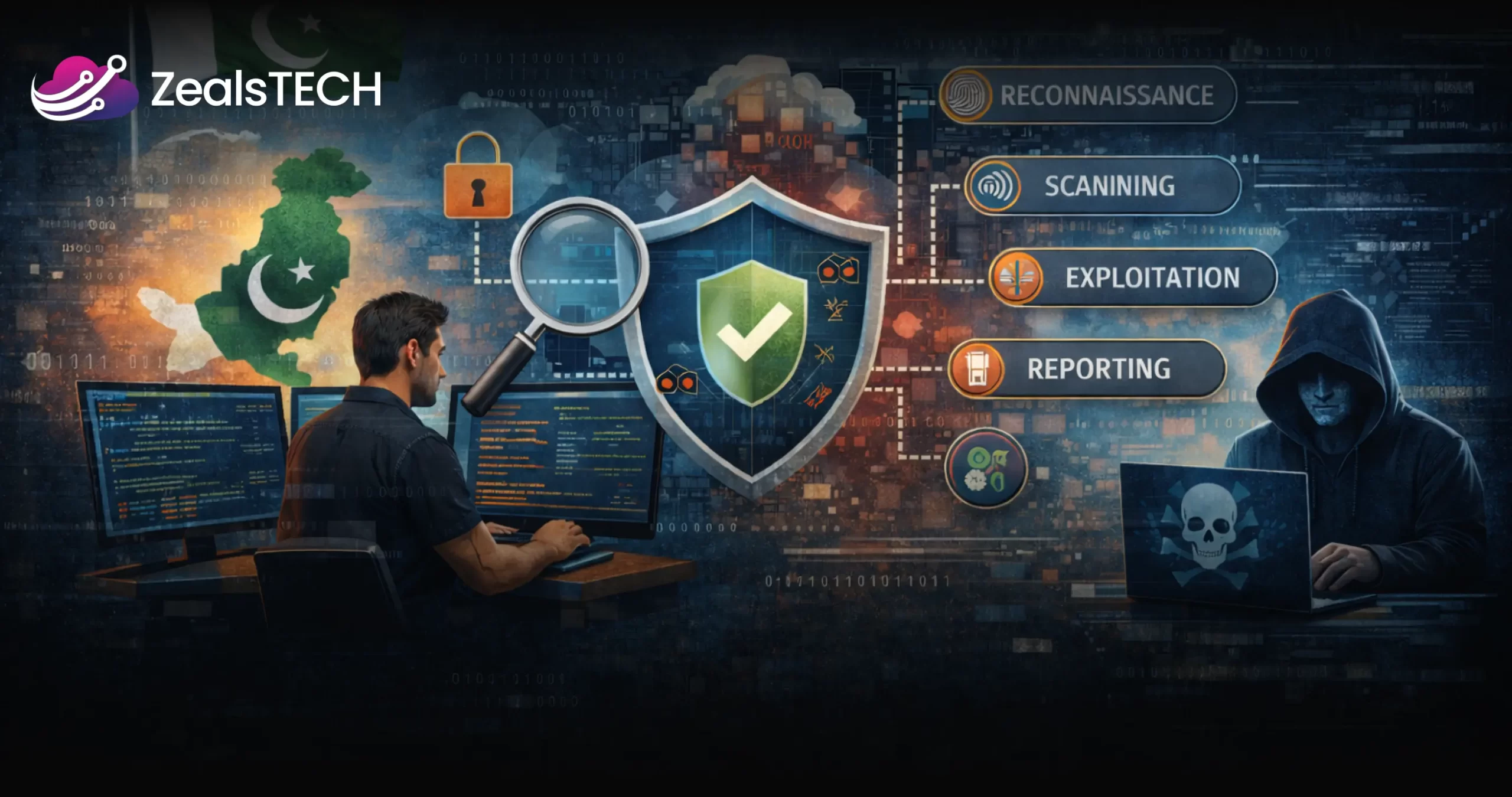
A professional test follows a structured penetration testing process. It’s planned, scoped, and tied to business needs. It’s not random, and it shouldn’t disrupt operations when done correctly.
1. Scoping and Planning
This step sets the boundaries and rules. The team agrees on:
- What systems will be tested
- The test type (black box, gray box, or white box)
- Rules of engagement (timing, access, limits)
- Key business risks and priorities
Clear scope keeps testing safe and focused.
2. Reconnaissance and Information Gathering
Testers collect details the way attackers do. Some info is public, and some comes from approved internal sources. Common targets include:
- Domains and subdomains
- Server and hosting details
- App endpoints and exposed services
- Network entry points and user access paths
This stage maps your attack surface, often revealing more exposure than expected.
3. Vulnerability Identification
Next, testers identify weaknesses through:
- Manual checks
- Careful validation of scan results
- Controlled attempts to confirm findings
This is where the work moves from “this might be an issue” to “this can be abused.”
4. Exploitation and Attack Simulation
Testers attempt to use confirmed flaws to learn:
- What data can be accessed
- Whether an attacker can move deeper into systems
- If sensitive areas (finance, admin panels, customer records) are reachable
This step proves real risk, which helps leaders prioritize fixes.
5. Reporting and Remediation Guidance
The final report turns technical findings into clear action. It usually includes:
- Verified vulnerabilities and proof of impact
- Severity ratings tied to business risk
- Step-by-step remediation guidance
- Suggestions to improve security controls long term
A good report supports both quick fixes and better planning.
Types of Penetration Testing That Fit Pakistani Businesses
Not every company faces the same threats. Testing should match how your business works and where your risk sits.
Web Application Penetration Testing
Web application security testing focuses on websites, portals, and SaaS platforms. It often checks for:
- SQL injection and input flaws
- Login and session issues
- Access control problems
- Data leaks and exposure
This is a must for customer-facing apps and business portals.
Mobile Application Penetration Testing
Application penetration testing for mobile apps reviews Android and iOS security, including:
- Insecure API calls
- Weak encryption
- Unsafe data storage on the device
- Auth and session weaknesses
It’s especially important for fintech, e-commerce, delivery, and service apps used by Pakistani customers.
Network Penetration Testing
Network testing checks both external and internal network security, including:
- Firewalls and perimeter controls
- Servers and endpoints
- Routers, switches, and segmentation
- VPNs and remote access paths
This fits companies with offices, branches, hybrid setups, or complex environments.
Cloud Penetration Testing
Cloud tests focus on access and setup problems, not “cloud is unsafe” myths. Most cloud issues come from mistakes in configuration. Testing often covers:
- Identity and access controls
- Storage permissions
- Exposed services
- Cloud-hosted apps and admin tools
This matters for teams using AWS, Azure, or Google Cloud.
API Penetration Testing
APIs connect apps, mobile clients, and third-party services. API testing checks:
- Broken authentication and authorization
- Data exposure through endpoints
- Rate limit and abuse controls
- Injection and logic flaws
APIs are a common path into modern systems, so this test is often high value.
When Pakistani Companies Should Run Penetration Testing
Penetration testing works best when it happens before an incident. Common times to schedule it include:
- Before launching a new website or app
- After major updates, re-designs, or infrastructure changes
- During cloud migration or major cloud changes
- Before onboarding large enterprise or global clients
- On a regular schedule as part of security planning
As a company grows, security gaps often grow with it. Regular testing keeps risk from piling up.
Vulnerability Assessment vs Penetration Testing
Teams often mix up vulnerability assessment vs penetration testing. They are related, but they aren’t the same.
- A vulnerability scan is automated and lists possible issues.
- A penetration test is human-led and confirms what can be exploited.
- Scans offer limited context, pen tests show business impact.
- Scans don’t simulate attacks, pen tests do.
Both have value. Scanning can be frequent, while penetration testing gives deeper proof when decisions matter.
Common Vulnerabilities Found in Pakistani Business Systems
During testing, teams often find familiar issues, such as:
- Weak passwords and poor authentication
- Insecure file uploads
- Misconfigured servers and cloud resources
- Broken access control
- Outdated software and plugins
- Exposed APIs, admin panels, or test environments
Most of these are fixable once they’re visible.
How Penetration Testing Improves Business Security
Penetration testing is more than a technical checkbox. It strengthens security in practical ways, including:
- Better risk awareness for leadership
- Clear ownership of fixes across IT and dev teams
- Improved incident response readiness
- Stronger long-term planning and controls
It also supports data breach prevention strategies by showing where attackers can enter and what they can reach.
Choosing the Right Penetration Testing Partner in Pakistan
Many vendors offer cybersecurity services in Pakistan, but quality varies. When choosing a partner, look for:
- Strong manual testing skills, not tool-only results
- Reports that are clear, prioritized, and actionable
- Experience with web, mobile, cloud, and APIs
- Ethical testing practices with proper approvals
- An approach that reduces risk without scare tactics
The right team helps you fix problems and build confidence.
Final Thoughts
Penetration testing gives Pakistani companies a clear view of their real security posture. It turns assumptions into evidence and helps teams fix issues before attackers exploit them. With more businesses moving online, penetration testing in Pakistan is one of the most practical steps you can take to protect customer data, avoid downtime, and maintain trust.
If security affects your revenue, brand, or customer relationships, penetration testing isn’t a cost to ignore. It’s a sensible way to stay in control.